The Wound
Congratulations. Your app compiled. Now meet reality.
The zinger is not that everyone can build an app now days. The great joke is that everyone thinks building one is the arrival.
You know the moment when a founder, a junior developer, a bored executive, or some glitter-eyed “AI product visionary” enters the room with a demo. The screens move. The buttons behave. Intoxicated by the illusion of genius. The chatbot answers in confidence of a junior consultant wearing his father’s cufflinks. You lean back with subconscious neurons throwing an after party, “we have conquered the market”. In truth, what you are witnessing is a well designed cage, and you are about to be trapped in it.
- This matters because Appfigures reveals 414,000 new iOS and Android apps were released in the first quarter of 2026, a 115% increase signalling rapid, frictionless churn (Boston Consulting Group, 2026).
- Despite this synthetic avalanche, merely 118 new apps achieved high-traction status, exposing a brutal 0.02% hit rate for these digital experiments (Page & Holmström, 2023; Accenture, 2026).
- AI implementations in the Fortune 500 face massive friction, with 74% failing to reach scale due to an intelligence-system decoupling where intent evaporates across nodes (Schlegel et al., 2023; PwC, 2026).
- McDonald’s Drive-Thru AI (with IBM) failed to scale, as it struggled with background noise and accents, resulting adding thousands of dollars of unwanted items to customer orders.
- Volkswagen’s Cariad Unified AI OS suffered from severe integration gaps and software bugs, resulting in over $7.5 billion in operating losses.
- IBM Watson for Oncology AI rollout created failure waves as It routinely provided unsafe, hallucinated treatment recommendations, leading hospitals globally to cancel their multi-million dollar contract – simply because it used narrow, synthetic training data rather than real-world patient complexities.
- Taco Bell Voice AI suffered from severe edge-case confusion, famously processing bizarre orders like “18,000 waters”, resulting in national mockery and a heavily slowed rollout.
- A viral Artistic Avatar Generating app by Prisma Labs secured $30 million seed funding only to burn 80%+ in revenue months later and crash.
- Hundreds of micro-startups launched and saw their subscriber bases vanish overnight. As soon as ChatGPT launched native PDF uploads, and Apple/Google integrated writing tools into their products.
- The code may look alive while quietly carrying a knife in its sleeve, at least 45% of AI-generated code contains dangerous vulnerabilities, including failures to verify market bases or users before granting access to sensitive data (Kaspersky, 2026).
- The gap between data storage and data in motion is where most intelligence-driven projects fail to find their pulse, leaving 81% of firms confusing repeated iterations with genuine momentum (Westenberger et al., 2022; Deloitte, 2025).
TEA SNAPSHOT — How It Unfolded
T — Transaction: The Prototype Pretended to Be a Product.
What exchange failed in the vibe-coded app rush?
You mistake a prompt to a machine for a transaction with a market. The exchange is isolated strictly between the developer and the large language model, leaving the actual customer entirely absent from the causality loop (Hou et al., 2023; Harvard Business Review, 2026).The app did not exchange meaningful utility for sustained attention, trust, money, or behavioural commitment. It merely exchanged novelty for applause. A prototype can earn curiosity. A product must earn repetition and scale.
E — Event: Isolated Ideation Catalysis Unintended Consequences.
What event does this sterile isolation trigger and what are the consequences?
It triggers the launch of a ghost. An application materialises in the marketplace, fundamentally disconnected from any human validation or structural necessity.It is an event lacking a pulse i.e. when 414,000 apps can arrive in one quarter and only a microscopic fraction achieve meaningful traction, the event is not innovation. It is market fog. The visible outcome is an explosion of supply. The hidden wound is collapse of differentiation.
A — Agent: The Exposed Actor Is Not AI, It’s Governance.
Who or what was exposed by the vibe-coding boom?
The exposed agent is the human system around the code: founder, business owner, developer, agency, investor, governance layer, and occasionally the poor business development team handed a trembling MVP like a newborn crocodile.The developer abdicates their strategic agency to the algorithm. They become a passive bystander in their own creation, stripped of the authority to govern the underlying momentum. Meanwhile, AI does not negotiate with the feelings, it simplyexposed who had no product discipline, no data discipline, no security discipline, no retention model, no distribution engine, and no sober grasp of scale.
Under the TEA Framework, we do not permit magical events to occur in isolation. Every meaningful shift is the direct consequence of a specific exchange between exactly two agents. Your vibe-coded marvel lacks this atomic pulse.
What went wrong, well everyone assumes the critical exchange is “prompt to code”. It was not. The real exchange is “market pain to repeatable value”. The fact that particular transaction was never engineered, the event became saturation, and the agent exposed was the operating system around the founder and the developer. The ghost is never the app, it is the missing business logic and coding standard inside it.
The Lesson: Rude Awakening
Founder are seeking Arrival Economics. Developer are after LinkedIn Gallantry.
The lesson is wonderfully brutal.
AI may have removed the barrier to entry. It has not removed the barrier to competence.
Anyone armed with a Mac Mini and a subscription can vibe code their way into an App Store. However, economies of scale and execution infrastructure remain strictly human domains, and they fail us every single time we abdicate our responsibility (Barros et al., 2024; MIT Sloan, 2025).
The Prompt . The Delusion . The Decay#TheMomentumArchitect #TSKMomentum #AIMomentum
When a barrier falls, talent enters. So does noise and so does incompetence in a velvet cape. A person can now ask AI to write code, generate an interface, draft a roadmap, assemble a pitch, and simulate the scent of a company before the idea even acquires the muscle to stand upright.
Distinction must stand tall, “vibe-coding” is metaphysically different from “AI-assisted coding”. AI-assisted coding works with judgement, whereas, vibe-coding often replaces judgement with theatrical confidence. One says, “Help me build what I understand.” The other says, “Understand it for me, then make me look visionary.”
That is not democratisation, nor singularity . That’s entropy.

I have observed the “Ambition Trap” from many sides, i believe you a have too.
In one instance, a junior developer, boisterous on “vibe-coding”, white washed it as revolutionary economic product AI product for digital marketing agencies. Promised saw traction while entropy revealed total infrastructure knowledge incompetency. In last known stand developer threw the burden of scale onto “Business Development” as if his job was limited to a buzzer sounding at 6:00 AM and leave the sun to handle sunrise.
In another, a veteran inspired by a weekend of YouTube binging, begins resurrecting a file-based ERP monolith, complete with business logic and web-scaling fossilised inside the code like a mammoth stuck in cheap ice. If resurrection needed proof, then year 2005 had just walked the earth. Conversely, founders are flirting with such a surplus of half-formed visions under the grand AI revolution, that they effectively end up curating an investment portfolio of three-legged tables; an expensive, decorative array entirely incapable of bearing the weight of market reality.
Multiple Points of Failure (MPOF)
- Scalability Collapse: These prototypes shatter under the weight of real-world traffic, revealing the vast chasm between a cute idea and an enterprise system of motion.
- Lack of Visibility: Enterprises are blind to what is being built within their own walls, cultivating a toxic inventory of uncatalogued “shadow AI”. If it has term AI to it narrative economics applauds it and arrival fallacy deems it sacramental contract.
- High Saturation: Analysis from late 2025 indicated that an overwhelming majority up to 78% of AI startups launched were essentially thin API wrappers built on top of foundation models like GPT-4 or Claude. Thats just an insulting to the concept of RAG.
- Data Exposure: Thousands of applications launch lacking basic authentication, exposing financial and medical records to the public ether because the prompter forgot to ask for locks (Negri-Ribalta et al., 2024; Forrester, 2025).
- No Audit Trails: Natural language prompts offer absolutely no traceability. The code cannot be audited for integrity, completely violating the required diagnostic clarity.
- Insecure Defaults: A staggering reliance on algorithms produces applications with atrocious dependency management and zero encrypted storage (Dou et al., 2025).
- Broken Compliance: Developers harbour the delusion that asking an AI to document compliance is sufficient, ignoring tightening global privacy regulations entirely.
- Monatisation Fallacy: Compared to conventional Software Monatisation Models, AI applications have not yet configured a wider commercial model beyond basic tokenisation or credits.
- Investor Caution: First quarter of 2026 saw accelerators reject 70% of AI startup applications specifically for being simple wrappers without real,, underlying technology.
Bell Curve: Build, Flood, Vanish
That is the new bell curve.
First comes the upward rush. The prompt works. The demo glitters. Investors lean forward. LinkedIn performs its little theatre of “game-changing” applause. YouTube buzzing with podcasts and intros.
Then comes the flattening. Downloads slow. Users drift. Bugs gather like unpaid invoices. The AI wrapper starts looking less like a sovereign product and more like a very expensive coat placed over someone else’s engine.
Then comes the drop. A beautiful little collapse with a lovely logo. No drama. Just Worse. Simply Quiet irrelevance.
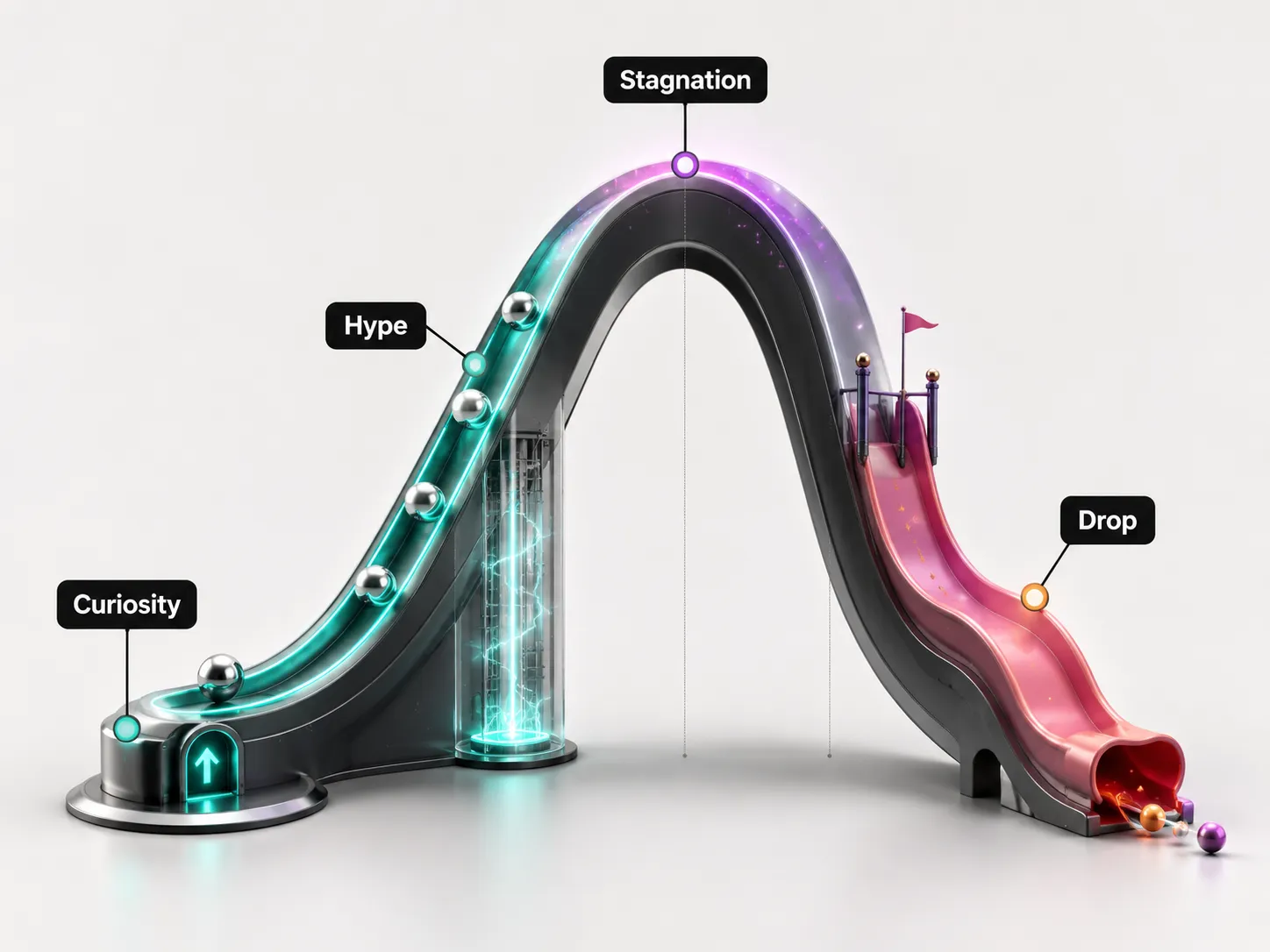
This narrow, linear trajectory creates a brutally predictable bell curve. You see a strong upward incline of early adoption, a rapid stagnation, and a sudden, fatal drop. You are no longer a sovereign creator. You are a hostage to your own synthetic infrastructure.
The Shift, The Pattern, The Frontier
The world has moved from “can we build?” to “should this exist, and can it survive?”
The shift is not from developer to non-developer. It is from software scarcity to software excess.
Scarcity rewarded the person who could build. Excess rewards the person who knows what deserves to be built. That is the historical correction now unfolding.
Invisible & Embedded Infrastructure
The single biggest existential correction in the domain, AI is losing its standalone identity.
- The Correction: Consumers and enterprises are tired of managing 50 different monthly subscriptions for individual AI micro-apps.
- The Impact: AI features have been quietly swallowed by core platforms. Intelligence is now natively integrated directly inside Google Workspace, CRM systems, ERP frameworks, web browsers, and phone operating systems. AI is becoming an invisible background layer. This is where the next business opportunity sits, if you need to avail one.
From “Prompting” to “Workflow Redesign”
The single biggest operational correction is the death of isolated prompts.
- The correction: Companies are mapping out entire business operations and automating the predictable components. Instead of asking “What is the best prompt for this?”, teams are asking “Which multi-step process can this layer own?”
- The Impact: Redesigning core workflows to natively include AI is projected to unlock nearly $3 trillion in business value over the next few years.
The Rise of “Agentic AI” over Chatbots
AI is shifting from a static assistant that answers questions to a network of active digital coworkers.
- Single-Turn to Multi-Turn Execution: Instead of generating text one prompt at a time, Agentic AI systems can independently take a high-level goal, outline a plan, and execute actions across multiple cloud platforms.
- Multi-Agent Ecosystems: Gartner reports that up to 40% of enterprise software applications incorporate task-specific AI agents. Complex tasks are solved by a “team” of internal AIs working together. For example, one AI agent creates code, while a secondary “skeptic” AI agent audits it for security vulnerabilities before deployment.
The Hard Pivot to Governance
Unstructured data set and governance has become the ultimate bottleneck for scaling AI and industry wide penalisation has begun.
- Most corporate data is trapped in messy, disconnected silos. Corporate spending is shifting heavily toward data preparation.
- Companies are racing to set up strict permission controls, automated sensitive data removal, and explicit data indexing so autonomous agents can interact with business contexts safely.
Building Momentum
Strategy is not repaired at the summit. It is audited at the node.
The shift matters because not every app must become a venture-scale business. Some should remain personal tools. Some should become internal workflows. Some should never be allowed within forty feet of customer data, payment rails, or regulatory exposure. Otherwise “Shadow AI” is not the glamorous more so like the kind “your compliance officer has stopped blinking”.
Stop optimising motion instead of movement or you will quietly join the graveyard of forgotten prompts. Strip away the posh interface and ask yourself what actually transacts beneath the glass using ISTM Protocol.
Move before machine redefine your authrity.
I — Intelligence: Identify Battle Wounds Before You Build the Crown.
How do you extract actual intelligence from synthetic noise and know whether a vibe-coded idea deserves to become a product?
First, start with the pain, not the tool. Identify the transaction the app must improve, the user behaviour it must change, and the evidence that someone cares enough to return. If you cannot name the recurring pain, you are not building a product. You are decorating a guess.Secondly, stop measuring the volume of code generated. It is an embarrassment. Demand diagnostic clarity by identifying the exact intent and inward impact of every operational node. If the decision cannot survive the chain, it was never a decision.
S — System: Replace Demo Logic With Buisness Operating Logic.
How do you stop an AI prototype becoming a fragile little palace of cards and anchor these fragile applications into reality?
First, convert abstract algorithmic outputs into rigid workflows, rules, and constraints. The system must carry the intelligence. It must force execution continuity entirely independent of the developer’s memory or the algorithm’s mood.Then, build the system around it before you scale it. Define authentication, data flow, ownership, support, monitoring, compliance, and failure handling. A demo may survive charm. A system survives pressure.
T — Transform: Must Remove the Old Fantasy, Not Just the Old Code.
What must change before AI-assisted software can create real value and prevent immediate, silent decay?
The organisation must stop treating AI as a shortcut around competence. Isolate new logic from legacy pathways immediately. You must deliberately replace the underlying system logic at the decision execution layer. Treat partial change as a controlled illusion.Transformation means replacing the fantasy that “the tool will solve it” with a discipline of problem selection, process design, security review, commercial modelling and user proof.
M — Momentum: Make Retention the First Victory, Not the Last Excuse
How do you restore movement when the application inevitably stalls and the first app launch glow fades?
Track repeat usage, trust signals, support burden, conversion friction and retention before celebrating downloads. Eliminate stop and start cycles by making bottlenecks visible in real time.Momentum is not launch volume, nore a its a traffic velocity. It is the measurable, unyielding continuity of defined transactions over time.
The “killer app idea guy” is dead, he was always slightly exhausting anyways.
His replacement “the vibe coder” isn’t automatically any better either.
He is faster, louder, cheaper to indulge, and considerably more dangerous when nobody in the room knows where software ends and business logic begins.
The lesson is not “do not build”. Build by all means and intent but build with sovereignty.
Build with TEA framework in mind, so every outcome traces back to a real transaction.
Build with ISTM Protocol, so every decision survives the chain.
Build with Enterprise Momentum Architecture governance, so your app does not become tomorrow morning’s breach notification wearing your logo.
AI has removed the moat around building. Now moat rests in judgement and that, my dear friend, is where the amateurs begin to drown beautifully.
So, when your app compiles, do not ask whether it is alive.
The real question is: whether the market, the system and the governance can keep it alive?

References
Accenture. (2026). The App Store Graveyard: Why Day-30 Retention is the New Moat in the AI Era. Accenture Technology Research.
Barros, L., Tam, C., & Varajão, J. (2024). Agile software development projects: Unveiling the human-related critical success factors. Information and Software Technology, 170, 107432.
Boston Consulting Group [BCG]. (2026). The Synthetic Deluge: Market Saturation and the Friction of ‘Vibe-Coded’ Products. BCG Platinion.
Deloitte. (2025). Enterprise Architecture in Motion: Bridging the Gap Between Data Storage and Data Execution. Deloitte Digital Insights.
Dou, S., Jia, H., Wu, S., Zheng, H., Wu, M., Tao, Y., Zhang, M., Chai, M., Fan, J., Xi, Z., Zheng, R., Wu, Y., Wen, M., Gui, T., Zhang, Q., Qiu, X., & Huang, X. (2025). What’s Wrong with Your Code Generated by Large Language Models? An Extensive Study. arXiv.
Ernst, N. A., Bellomo, S., Ozkaya, I., Nord, R. L., & Gorton, I. (2015). Measure it? Manage it? Ignore it? software practitioners and technical debt. Proceedings of the 2015 10th Joint Meeting on Foundations of Software Engineering, 50-60.
Forrester. (2025). The Shadow AI Crisis: Governance and Compliance Breakdowns in Zero-Code Environments. Forrester Research Institute.
Gartner. (2025). Hype Cycle for Generative AI in Software Engineering: The Visibility Gap and Uncatalogued Dependencies. Gartner IT Symposium.
Harvard Business Review. (2026). The Agency Dilution Problem: When the Prompt Replaces the Strategist. HBR Press.
Hou, X., Zhao, Y., Liu, Y., Yang, Z., Wang, K., Li, L., Luo, X., Lo, D., Grundy, J., & Wang, H. (2023). Large Language Models for Software Engineering: A Systematic Literature Review. arXiv.
IBM. (2026). Sovereign Execution vs. Synthetic Drift: Reclaiming Agency in Automated Workflows. IBM Institute for Business Value.
MacCormack, A., & Sturtevant, D. J. (2016). Technical debt and system architecture: The impact of coupling on defect-related activity. Journal of Systems and Software, 120, 170-182.
McKinsey & Company. (2026). The Price of Attention: Soaring Customer Acquisition Costs in a Saturated Digital Ecosystem. McKinsey Digital.
Min, S., Zhang, X., Kim, N., & Srivastava, R. K. (2016). Customer Acquisition and Retention Spending: An Analytical Model and Empirical Investigation in Wireless Telecommunications Markets. Journal of Marketing Research, 53(5), 728-744.
MIT Sloan. (2025). Human Infrastructure in the Age of Automated Generation: Why Scale Remains an Organic Challenge. MIT Sloan Management Review.
Negri-Ribalta, C., Geraud-Stewart, R., Sergeeva, A., & Lenzini, G. (2024). A systematic literature review on the impact of AI models on the security of code generation. Frontiers in Big Data, 7.
Page, A., & Holmström, J. (2023). Enablers and inhibitors of digital startup evolution: a multi-case study of Swedish business incubators. Journal of Innovation and Entrepreneurship, 12.
PwC. (2026). The Execution Deficit: Why 74% of Fortune 500 AI Pilots Never Reach Sovereign Scale. PwC Strategy&.
Schlegel, D., Schuler, K., & Westenberger, J. (2023). Failure factors of AI projects: results from expert interviews. International Journal of Information Systems and Project Management, 11(3), 25-40.
Westenberger, J., Schuler, K., & Schlegel, D. (2022). Failure of AI projects: understanding the critical factors. Procedia Computer Science, 196, 69-76.
Olavsrud, T. (2022). 12 famous AI disasters. CIO.